If Atomic Elements look correct inside a legacy Elementor Loop Item but break, stack, or lose alignment on the live Loop Grid, the editor preview is giving you a misleading compatibility signal. As of July 2026, Elementor says the legacy Loop Grid does not fully support Atomic Elements on the frontend, even though the editor may preview them correctly.
This guide fixes that specific architecture mismatch. It shows how to prove that you have Atomic Elements inside a legacy Loop Item, replace them safely with equivalent legacy widgets, preserve the query and dynamic data, and test the repaired grid. It also explains the opposite migration direction that Elementor does support: placing legacy V3 Loop Item content inside the newer Atomic Loop.
Quick answer: Do not try to repair this with extra CSS first. Back up the site and export the Loop Item template. On staging, open the legacy Loop Item used by the Loop Grid, identify every Atomic Element in Structure, and rebuild those elements with equivalent legacy widgets. Keep the existing legacy Loop Grid, query, dynamic tags, and template assignment unchanged. Update the template, clear only the relevant generated files and caches, then test several items, responsive breakpoints, pagination or AJAX loading, and a logged-out browser. If you want an Atomic architecture, build a native Atomic Loop separately; Elementor currently documents legacy V3 content inside an Atomic Loop as a temporary bridge, not the reverse combination.
Identify the loop architecture before changing anything
| What the page contains | Current expectation | Safest next move |
|---|---|---|
| Legacy Loop Grid + legacy widgets in its Loop Item | Supported legacy path | Diagnose ordinary CSS, data, or cache issues |
| Legacy Loop Grid + Atomic Elements in its Loop Item | Editor may look right; frontend can break | Replace Atomic Elements with legacy widgets |
| Native Atomic Loop + Atomic Loop Item | Native V4 path | Diagnose the Atomic Loop itself |
| Native Atomic Loop + copied legacy V3 Loop Item content | Documented temporary migration bridge | Verify copied content, dynamic data, and template IDs |
| Architecture is unclear | No reliable diagnosis yet | Inspect Structure and record the selected parent element |

Before editing the template: create a restorable database-and-files backup, clone the problem to staging, and export the affected Loop Item. Record the page URL, template name and ID, query source, filters, pagination type, items per page, responsive column settings, and any custom query ID. A Loop Item is reused, so one careless edit can change every page that references it.
Why the editor and frontend disagree
Elementor’s current FAQ directly describes this symptom: Atomic Elements can appear correct in a Loop Item preview because the editor rendering engine is more flexible, while the legacy Loop Grid frontend does not yet fully process those elements. The result may be broken structure, unexpected stacking, missing spacing, or alignment that differs from the editor.
That makes this different from the familiar “changes do not appear online” problem. A stale cache serves an older valid render. This compatibility mismatch can produce a fresh but structurally wrong render. Clearing caches repeatedly cannot add frontend support to an unsupported parent-child combination.
The two mixed-version directions are not equivalent
Elementor V4 can coexist with V3 elements on ordinary canvases, but that general coexistence does not prove every specialized widget supports both architectures internally. Elementor documents a specific bridge for loops: existing V3 Loop Item content can be copied into an Atomic Loop while a site transitions. Elementor separately warns that Atomic Elements inside the legacy Loop Grid are not fully supported on the frontend. Treat those as two different directions, not as permission to mix either way.
1. Reproduce the failure on staging
Start with a controlled copy because the broken template may be shared by archives, related-post sections, product listings, search results, or landing pages. The aim is to reproduce the same mismatch without exposing visitors to experiments.
- Create or refresh staging from the current live site.
- Open the exact frontend URL in a logged-out or private browser and capture desktop and mobile screenshots.
- Record which items break and whether the first page, later pages, or AJAX-loaded items differ.
- Open the page in Elementor and note the Loop Grid’s selected Loop Item template.
- Confirm the staging copy shows both the correct editor preview and the broken frontend result.
If staging does not reproduce the problem, compare Elementor Core and Pro versions, feature settings, the active theme, optimization settings, caches, and the template ID selected by the Loop Grid. Do not edit live until you know which environmental difference changes the result.
2. Confirm the parent is the legacy Loop Grid
Select the repeated listing on the page and use Elementor’s Structure window rather than judging by appearance. Elementor’s legacy documentation calls the parent widget Loop Grid and exposes a chosen Loop template plus columns, items per page, and masonry settings. The newer Atomic Loop instead has a structural hierarchy of Loop, Loop Layout, and Loop Item.
- If the parent panel says Loop Grid and lets you choose a separate Loop Item template, continue with the legacy repair in this guide.
- If Structure shows the native Atomic Loop hierarchy, stop. This exact compatibility warning is not your diagnosis.
- If a Template widget, shortcode, Posts widget, or third-party loop creates the listing, diagnose that component instead.
3. Find Atomic Elements inside the Loop Item
From the legacy Loop Grid, edit its selected Loop Item template. Expand every nested layer in Structure. Record each element that came from the Atomic Editor and the dynamic value, link, class, variable, responsive rule, and accessibility setting applied to it.
| Atomic item to record | What must survive replacement | Likely legacy equivalent |
|---|---|---|
| Heading or Paragraph | Dynamic title/excerpt, HTML level, typography, link | Heading or Text Editor widget |
| Image | Featured image tag, size, alt source, link, ratio | Image or Featured Image widget |
| Button | Dynamic URL, label, target, attributes, states | Button widget |
| Div Block or Flexbox | Direction, wrap, gap, alignment, padding, semantic tag | Legacy Container |
| Atomic classes or variables | Actual computed design values | Widget/container styles or suitable legacy global settings |
Do not assume that copying a class name transfers its behavior. Atomic classes and variables belong to the V4 styling model. For this repair, capture the visible and responsive design values so you can reproduce them with legacy controls. If the wider problem is an Atomic class that fails even outside loops, use the separate Elementor V4 class frontend guide.
4. Duplicate the Loop Item and make a small proof
Duplicate the affected Loop Item instead of dismantling the only working reference. Name the copy clearly, such as Staging – Legacy Loop Repair. Replace one simple Atomic Element first—usually a title—with its legacy equivalent, reconnect the same dynamic tag, and assign the copied template to a duplicated test page.
- Duplicate the Loop Item and the page that displays it.
- Replace one Atomic heading or paragraph with a legacy Heading or Text Editor widget.
- Reconnect the original dynamic tag and link.
- Update the template and preview the duplicated page while logged out.
- Confirm the replaced element renders consistently across at least three different loop records.
Use a diagnostic difference: give the replacement a temporary, obvious style such as a colored top border. If that marker appears on every frontend item, you have proved the Loop Grid is loading the copied template and the replacement is reaching the live render. Remove the marker after verification.
5. Replace the remaining Atomic Elements with legacy widgets
Once the proof works, rebuild the Loop Item from the outside inward. Use legacy Containers for layout and legacy widgets for content. Change one logical group at a time so a failed dynamic tag or responsive rule can be traced to a specific replacement.
- Recreate the outer card container and its direction, width, gap, alignment, padding, border, background, and overflow behavior.
- Replace the image and reconnect Featured Image or the relevant dynamic source, including its link and alt behavior.
- Replace headings, metadata, excerpts, prices, or custom-field output and preserve their semantic HTML levels.
- Replace buttons and links, then verify dynamic URLs, new-tab behavior, and accessible labels.
- Recreate hover and responsive states using legacy widget or container controls.
- Remove the Atomic originals only after their legacy replacements match on the frontend.
Preserve dynamic context, not sample text
A Loop Item repeats against different posts or products. Replacing a dynamic title with the sample title visible in the editor creates a convincing but static card. Reopen every legacy widget’s Dynamic Tags setting and choose the same post, product, image, taxonomy, or custom-field source as before. Test records with long titles, missing images, sale prices, empty optional fields, and unusual characters.
Recreate responsive values explicitly
Inherited Atomic values may not map one-to-one to legacy controls. Check desktop, tablet, and mobile values for columns, gap, order, width, min-height, alignment, padding, typography, and visibility. If the cards overflow only on mobile, use the focused Elementor mobile layout guide after the architecture is supported.
6. Preserve the Loop Grid query and page-level settings
The unsupported elements are inside the item template; the legacy Loop Grid’s query does not need to be rebuilt merely to fix them. Keep the original source, include/exclude rules, order, item count, columns, masonry, alternate templates, custom query ID, and pagination configuration unless testing proves a separate fault.
Changing the query and the template in the same pass makes missing records, duplicate records, and layout changes difficult to attribute. Take screenshots of the Loop Grid settings before you switch its template. After the repaired copy passes testing, you can assign it to the original grid without changing the query.
7. Clear generated files and caches after the structural fix
Update the Loop Item and page first. Then clear Elementor’s relevant generated files/data and purge the page through the cache layers used by the site—WordPress cache, host/server cache, CDN, and browser. Test in a private window. This cleanup ensures you are viewing the repaired template; it is not the repair itself.
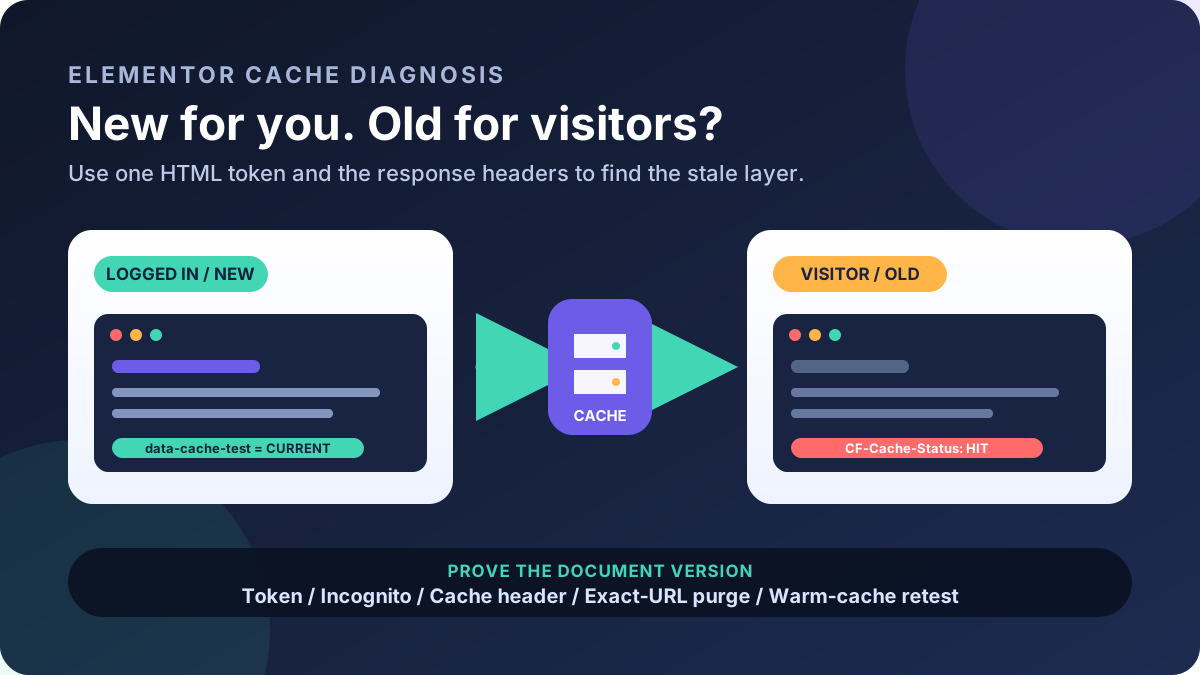
If the repaired template looks right while logged in but visitors still see the old one, follow the dedicated logged-in versus visitor cache workflow. If stylesheets return 404 errors, use the narrower Elementor CSS 404 guide.
8. Verify the repaired Loop Grid like a visitor
A single correct card in the editor is not a pass. The production check must cover repeated data, loading modes, responsive layout, and the business action inside the card.
- Open the page logged out on desktop, tablet, and mobile widths.
- Compare at least the first, middle, and last item on the page.
- Load a second page through page reload and through AJAX if that mode is enabled.
- Use taxonomy filters, search, alternate templates, or “load more” behavior if present.
- Test titles of different lengths, missing media, empty custom fields, and out-of-stock or sale states where relevant.
- Click the card, image, title, button, add-to-cart, or other primary business action.
- Check keyboard focus and confirm heading levels and image alternatives remain sensible.
- Review the browser console and network panel for new frontend errors or failed assets.
Success criteria: the legacy Loop Item contains only legacy widgets and containers; every tested record matches the intended desktop and mobile layout; dynamic content remains record-specific; pagination, AJAX, filters, and primary links work while logged out; and no new console or asset errors appear.
When to migrate to a native Atomic Loop instead
If the goal is to use V4 classes, variables, components, and native Atomic layout controls, replacing Atomic Elements with legacy widgets is a compatibility repair, not the final migration. Build a separate native Atomic Loop on staging. Elementor documents the Atomic Loop as an Elementor Pro feature with its own Loop, Loop Layout, and Loop Item structure, plus standard page-reload or AJAX pagination.
Use the documented bridge in the supported direction
Elementor’s July 20, 2026 Atomic Loop guide says existing V3 Loop Item content can be loaded inside an Atomic Loop as a temporary migration bridge. That lets a team move the parent architecture first and rebuild the item progressively. It does not mean Atomic Elements are supported inside the old Loop Grid.
- Leave the production legacy Loop Grid unchanged.
- Build an Atomic Loop on a staging page and reproduce the original query.
- Use native Atomic Elements for a new item, or copy the documented legacy V3 content into the Atomic Loop Item as a temporary bridge.
- Verify dynamic tags, responsive behavior, pagination, filters, and business actions.
- Compare performance and accessibility with the current production listing.
- Switch only after the Atomic version passes the full acceptance test and a rollback path is ready.
For a broader phased rollout, start with the Elementor V4 on an existing V3 site guide. If you are also modernizing old sections and columns, keep that separate and follow the sections-to-containers migration process.
Check template IDs when moving loops between sites
Elementor cautions that exporting, importing, or copy-pasting loops between sites can produce rendering errors when Loop Item template IDs do not match. After any cross-site move, explicitly reselect the intended template, save, and test the destination rather than assuming the source relationship survived.
Rollback if the replacement changes content or layout
If the repaired copy fails acceptance testing, keep the original Loop Grid assigned and continue on staging. If a live switch has already happened, reassign the exported or original Loop Item template, clear only the affected caches, and verify the business flow. Restore the backup only when template reassignment or revision recovery cannot return the site to the known-good state.
Before future Elementor updates, use the Elementor update checklist and include at least one legacy Loop Grid, one Atomic Loop, later pagination pages, and logged-out mobile in the regression set. Compatibility is version-sensitive, so recheck Elementor’s current FAQ and Atomic Loop guide before deciding the old limitation still applies.
Frequently asked questions
Will clearing Elementor CSS or cache fix Atomic Elements in a legacy Loop Grid?
Not when the root cause is the documented unsupported combination. Clear generated files and caches after replacing the Atomic Elements so the frontend serves the repaired template. If an all-legacy Loop Item still differs from the editor, then investigate caching, failed CSS, or another conflict.
Can custom CSS make the mixed template safe?
CSS may hide one visible symptom, but it does not make the legacy Loop Grid fully process unsupported Atomic markup. It can also fail on later items, responsive widths, filters, or AJAX pagination. Use the supported architecture first; add minimal CSS only for a verified design requirement afterward.
Should I disable Elementor V4 across the whole site?
Usually no. The narrow fix is to stop using Atomic Elements inside the affected legacy Loop Item. Other V4 content may coexist correctly elsewhere. A global feature change has a wider blast radius and should be tested as a separate rollback decision.
Can an Atomic Loop contain legacy V3 Loop Item content?
Elementor currently documents that as a temporary migration bridge. Build and test the Atomic Loop on staging, preserve dynamic data, and verify template IDs after cross-site moves. Do not reverse that statement into support for Atomic Elements inside a legacy Loop Grid.
What if Elementor adds full support later?
Recheck Elementor’s current documentation and changelogs on staging before migrating again. Keep the all-legacy production template until a native or newly supported version passes logged-out, responsive, pagination, filter, and business-action tests on the site’s actual Core and Pro versions.
Need help repairing a production loop safely?
If the Loop Item is shared across archives or the site mixes V3 and V4 in several templates, AbdullahWP can trace the actual loop architecture, rebuild the item on staging, preserve dynamic data and queries, test pagination and responsive states, and prepare a reversible deployment. See WordPress and Elementor services.