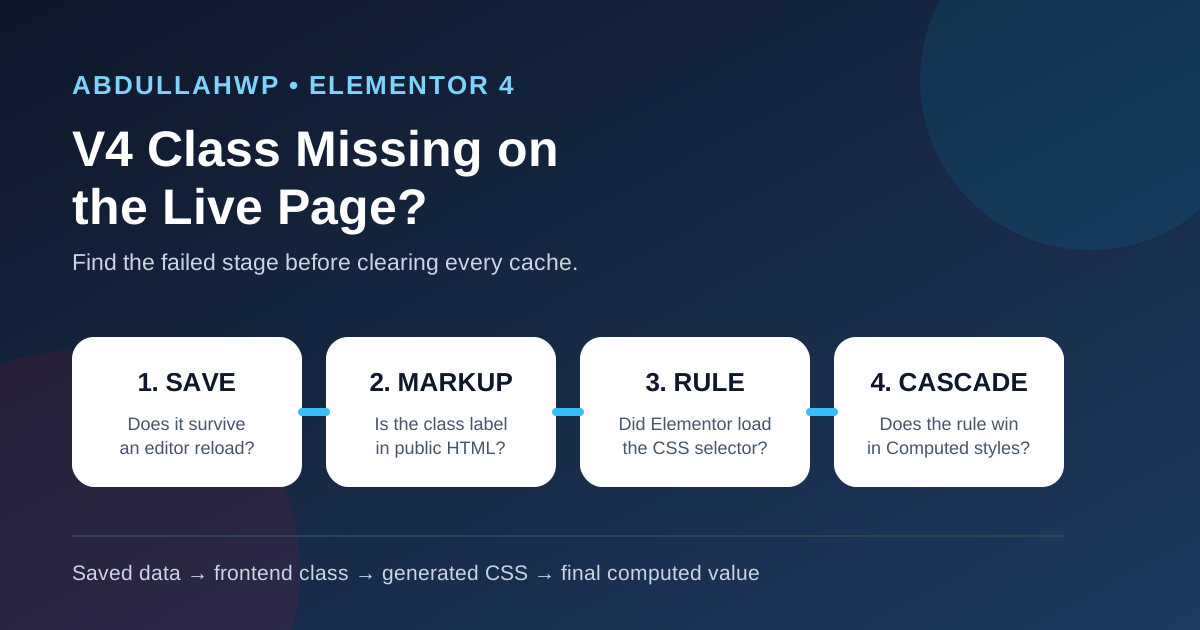
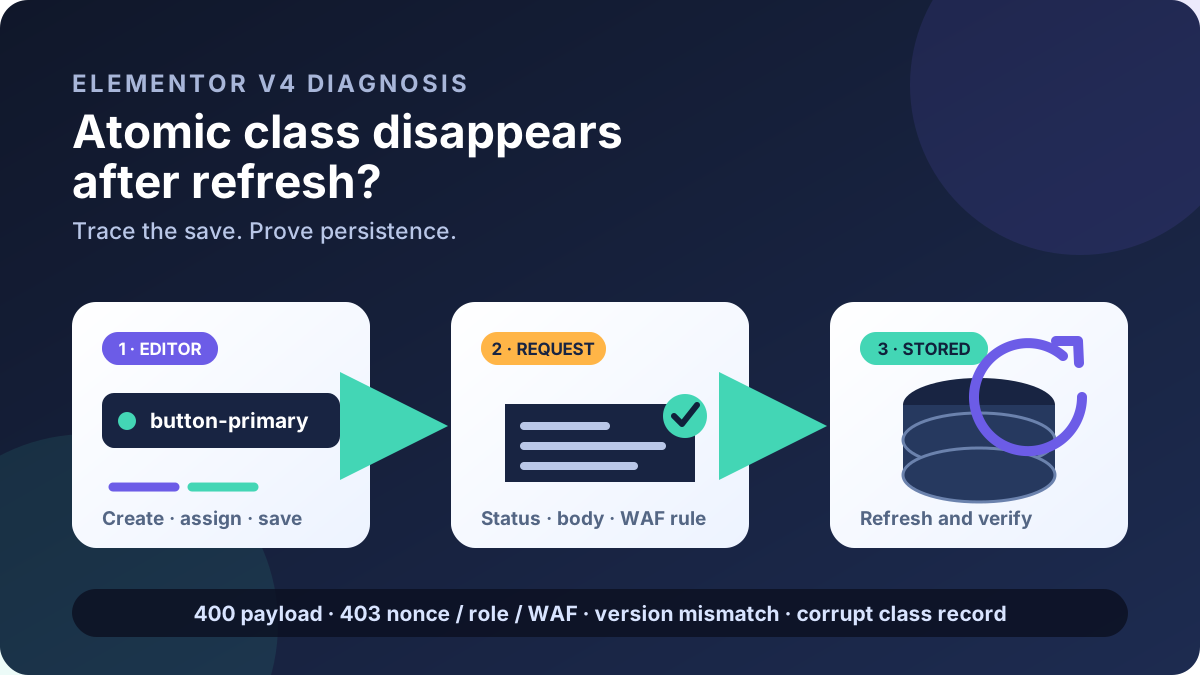
An Elementor Atomic class that disappears after an editor refresh has a persistence problem. The class definition, its assignment to the element, or both failed to reach storage. Clearing frontend CSS or changing selector specificity cannot repair a change that was never saved.
This guide is for Elementor Atomic classes not saving or disappearing when the editor reloads. It follows the save itself: reproduce with a disposable class, capture the exact request and response, distinguish a class-library failure from a page-document failure, and repair only the responsible layer. If the class survives a reload but does not affect the public page, switch to the Elementor CSS troubleshooting workflow; that is a different incident.
Quick answer: On staging, add a uniquely named class to one Atomic element, change one harmless property, save every prompt shown by Elementor, and hard-reload the editor. If it vanishes, repeat with browser DevTools recording Fetch/XHR requests. Read the response body as well as the status: reauthenticate for an expired nonce, use an authorized role, identify a WAF rule behind a 403, correct a rejected payload behind a 400, align Elementor Core and Pro, or replace one damaged class record only after proving that new classes save normally.
First, prove which part does not persist
Elementor’s current documentation describes an Atomic style as a reusable class definition with a stable ID, a user-facing label, and one or more breakpoint/state variants. Separately, the page document records which styles belong to each element. That gives you two related save targets:
- Class definition: the class still exists in Class Manager and retains its properties after a reload.
- Element assignment: the same element still lists that class after the document reloads.
| After a hard editor reload | Likely failing scope | Best next test |
|---|---|---|
| Class and assignment both disappear | The save workflow or request failed | Capture the save request and response |
| Class exists, but it is no longer on the element | Page document or element assignment | Assign it to a clean element on a new draft |
| Assignment remains, but edited properties revert | Class definition or Class Manager save | Edit a disposable new class and compare |
| Only one old class fails; a new class saves | Specific class record or reference | Duplicate/rebuild that class on staging |
| Everything survives reload | Persistence is working | Move to frontend markup/CSS diagnosis |
Protect the design system before testing
- Use staging for a shared class, header, footer, form, checkout, or campaign page.
- Take a database-and-files backup and confirm how it will be restored.
- Export the V4 Design System ZIP as a supplemental copy of variables and classes.
- Record WordPress, PHP, Elementor Core, Elementor Pro, theme, and add-on versions from Elementor System Info.
- Screenshot the class name, properties, usage list, error message, and time of the test.
Elementor’s design-system export includes the complete variables-and-classes collection; it cannot export one class selectively. Import conflicts can replace or keep existing items, so do not treat the ZIP as a risk-free substitute for a full database backup.
Do not delete the failing class or edit Elementor data directly in the database. Class Manager warns that deleting or renaming a shared class affects every element using it. Elementor also stores page data as structured JSON in WordPress metadata; hand-editing IDs, variants, or references can turn one recoverable record into a wider document problem.
1. Build a clean save probe
- Create a private staging page and add one native Atomic element.
- In its Style tab, create a unique class such as
save-probe-0724. - Set one obvious but harmless property, such as a two-pixel border.
- Use the page Update control and any separate Save changes control Elementor presents in the design-system workflow.
- Wait for the interface to finish, then hard-reload the editor.
- Search Class Manager for the class and reselect the element.
Do not reuse a common label or test first on the damaged page. A new document plus a unique class separates a site-wide save failure from one bad document or record. If the clean probe persists, repeat the same probe on a duplicate of the affected page.
2. Capture the request that actually saves
- Open browser DevTools and select Network.
- Enable Preserve log and filter to Fetch/XHR.
- Change only the probe property and save again.
- Open the request generated at that exact time. Do not assume its endpoint name.
- Record its URL, method, status, request payload, response body, and response headers.
- Redact cookies, nonces, tokens, personal data, and full admin URLs before sharing evidence.
| Network result | What it proves | Next action |
|---|---|---|
400 | The application rejected the request as sent | Read the response for the invalid field/data clue; compare a clean probe with the failing payload |
401 or nonce-related 403 | Authentication or session validation failed | Sign out, sign in over the canonical HTTPS URL, and retry once |
403 with a security page/rule ID | A permission or security layer refused the action | Check the user role, security log, ModSecurity, host WAF, or proxy rule |
413 | The request body exceeded a server/proxy limit | Compare payload size and ask the host which exact limit rejected it |
500 | Server-side processing failed | Match the timestamp to the PHP/server log |
200 but data reverts | Transport succeeded, not necessarily persistence | Read the response body and compare definition versus assignment after reload |
| Canceled or failed | The browser, network, proxy, or extension interrupted it | Retry in a clean browser profile and inspect Console/network errors |
Keep the response body. “403” is not a diagnosis. WordPress can return 403 for a failed REST nonce, Elementor documents security plugins and server firewalls as other 403 causes, and a custom role can lack the class action. The returned error text and the security log decide which path is real.
3. Fix a 403 without weakening the site
Start with the least invasive explanations. WordPress protects cookie-authenticated REST requests with a nonce and returns a 403 when that nonce is invalid. Open a fresh login session on the site’s canonical HTTPS hostname and repeat the clean probe once. If it works, the prior editor session had expired or become inconsistent.
If it still fails, test with a dedicated administrator on staging. Elementor limits class actions by role; its current guidance notes that an administrator can manage class features while an editor cannot create a new class. Do not permanently promote an editor merely to hide the restriction. Correct the intended role policy or have an authorized administrator manage the design system.
When the response or security log identifies a WAF, security plugin, or ModSecurity rule, ask its owner for the rule ID and reason. Temporarily use learning mode only during a controlled staging test, or create a narrow exception for the verified authenticated action. Retest, then remove temporary learning mode. Never allow all wp-admin, REST, or logged-in traffic through the firewall.
4. Isolate a rejected 400 payload
A 400 response means the request was unacceptable in its current form; it does not identify why. Use the clean probe as a control:
- If a one-property class saves but the original does not, duplicate the original on staging and add its properties back in small groups.
- If every new class fails, compare the failed response with a simple page update and check versions, permissions, and server logs.
- If failure begins only after a large edit, compare request sizes and let the response or host log confirm a body/input limit before raising one.
- If the request contains malformed or unexpected data associated with an add-on, disable that add-on on staging and reproduce with native Atomic elements.
- If the response names a field, variant, or data migration, preserve the response and exact versions for Elementor support rather than guessing at the database record.
A broad “increase every PHP limit” change is not evidence. Change a limit only when the rejected response, proxy log, or PHP/server log names it.
5. Align Core, Pro, and Atomic data versions
Elementor’s Atomic element schema includes a version used for data migrations. A partially completed update, incompatible Core/Pro pair, beta build, or outdated add-on can therefore be relevant when a save payload fails after an update.
- Download Elementor System Info and record exact versions.
- Read the matching Core, Pro, and add-on changelogs.
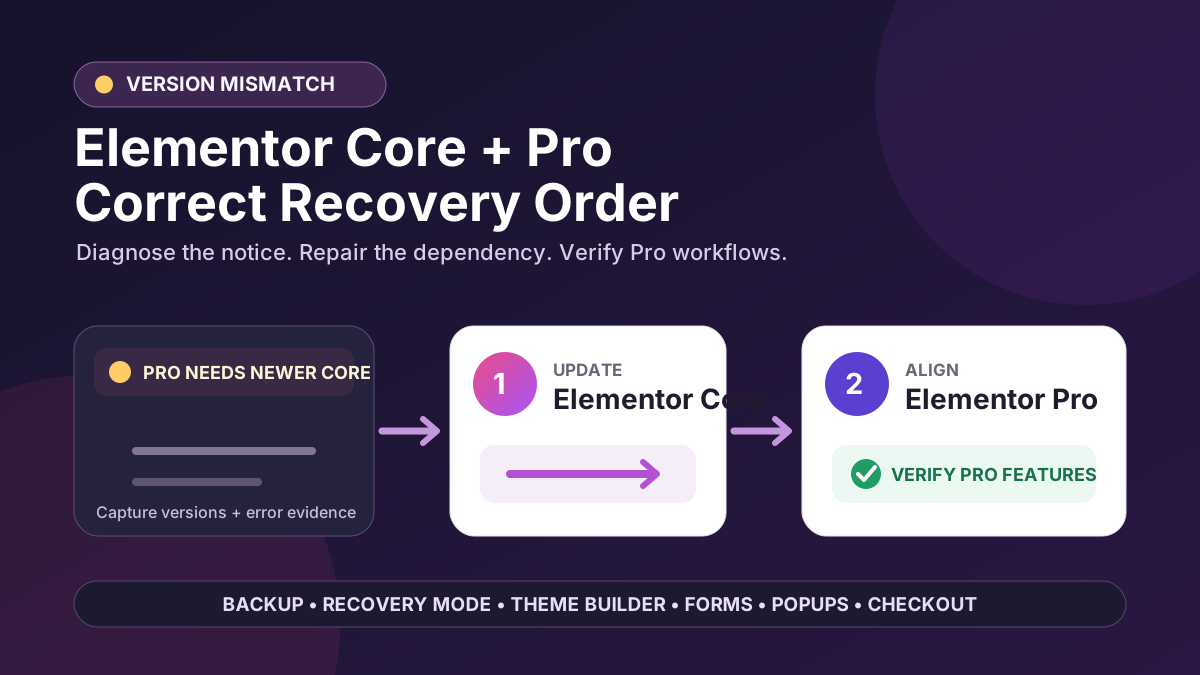
- Back up staging, then follow Elementor’s current order: update the free Core plugin first and Elementor Pro second.
- Use stable releases; move off Beta or Developer Edition for the confirmation test.
- Repeat the one-element save probe before re-enabling third-party Elementor add-ons.
Use the Elementor update checklist for the full dependency and acceptance-test process. Do not leave Core and Pro mismatched as a workaround, and do not install an untrusted older ZIP.
6. Repair one corrupt class record safely
Suspect a class-specific record only when new classes persist, the same user can save other changes, and one class repeatedly loses its definition or assignment. Then use a controlled replacement:
- Export the design system and take a fresh database backup.
- Use Class Manager’s usage locator and record every page, post, header, and footer that uses the class.
- Duplicate the class if Elementor allows it, or create a uniquely named replacement.
- Rebuild only the necessary properties manually; do not copy a malformed raw payload.
- Apply the replacement to one duplicate element and prove it survives two reloads and a new login session.
- Replace usages in controlled batches and verify each affected site part.
- Delete the original only after the usage locator shows it is unused and rollback has been tested.
If a new class survives on a clean page but disappears only on one existing page, repair the document instead: duplicate the affected element, restore a known-good page revision, or rebuild the smallest damaged section. Do not assume a page revision restores a sitewide class-library change; verify that separately on staging.
7. Treat 500 and database errors as server incidents
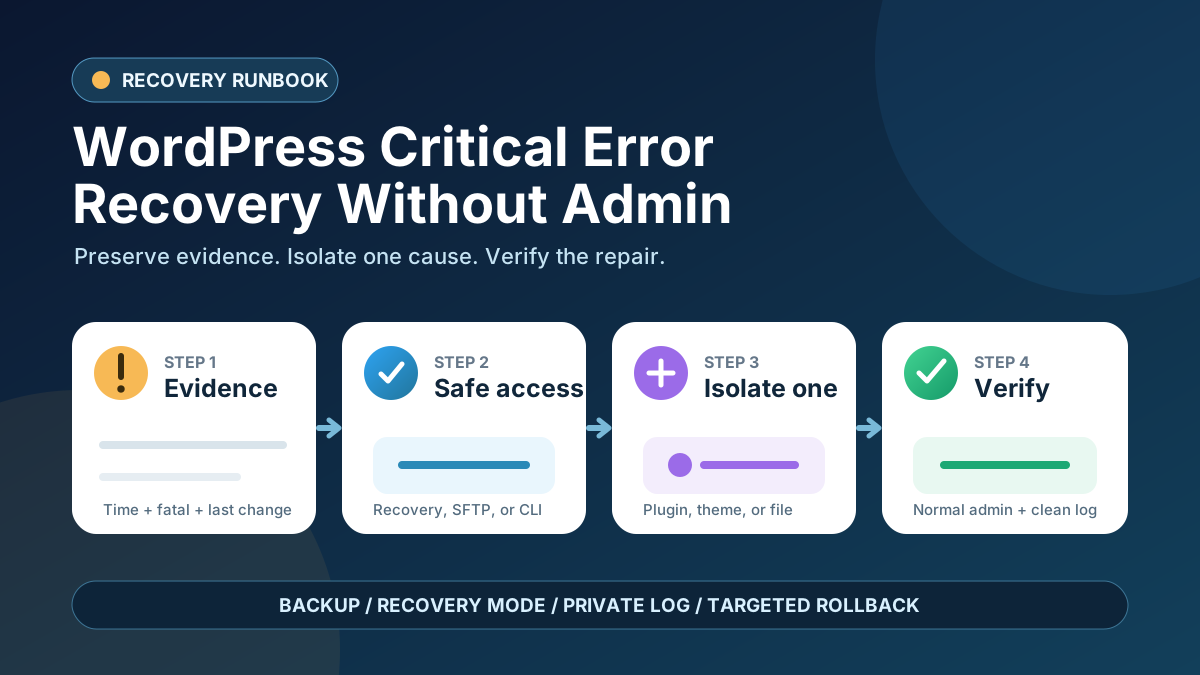
For a 500 response, reproduce once with a timestamp and read the host’s PHP/server log. On staging, WordPress documents using WP_DEBUG_LOG while keeping WP_DEBUG_DISPLAY off. Disable debugging after collecting the relevant lines, and never post an unredacted log publicly.
Fix the named fatal error, memory exhaustion, database write error, or plugin path. If the editor itself will not open, use the Elementor editor loading decision tree. If saving returns a confirmed server error, follow the focused Elementor 500 saving guide.
Verify the repair before touching production
- The class definition survives two hard editor reloads.
- The intended element retains the class assignment.
- A second authorized session sees the same class and properties.
- The save request returns an expected success response without an application error.
- The WAF/security log shows no new block for the action.
- PHP and server logs show no related fatal or database write error.
- A duplicate test element and the affected document both save successfully.
Success condition: the class definition and element assignment survive editor reloads and a fresh login, the save response is clean, and no temporary administrator permission, firewall learning mode, or mismatched plugin version is required. Only then continue to public-page CSS verification.
Rollback and prevent the failure returning
- Remove temporary WAF learning mode or test exceptions and confirm saving still works.
- Return users to least-privilege roles after the authorized task.
- If a version change caused a regression, restore the tested Core/Pro pair and database state rather than rolling back only one plugin.
- Keep routine database backups plus dated design-system exports before class-library changes.
- Test Elementor updates and add-ons with a create-edit-reload class probe on staging.
- Use stable, unique class names and keep a short ownership/usage record for sitewide classes.
- Monitor failed authenticated admin requests and retain WAF rule IDs in the change record.
Official sources for this workflow
- Elementor: Classes in Elementor
- Elementor: Class Manager
- Elementor: user roles and classes
- Elementor: import and export V4 design systems
- Elementor Developers: Atomic Styles data structure
- Elementor Developers: saved page data
- Elementor: Publish/Update button not working
- Elementor: Core and Pro update order
- WordPress: REST cookie and nonce checks
- WordPress: debugging and error logging
Frequently asked questions
Why does Elementor say it saved when the class still disappears?
The interface may have completed one action while the class definition or document assignment failed, or the response may contain an application error despite a successful HTTP transport. Reloading is the persistence test; the Network response shows which action failed.
Does a 403 always mean the firewall blocked Elementor?
No. An expired WordPress REST nonce, insufficient role permission, a security plugin, ModSecurity, a hosting WAF, or a proxy rule can all produce a 403. Use the response body and security log instead of disabling protections blindly.
Can an Elementor Editor role create Atomic classes?
Elementor’s current role guidance says class features are restricted and specifically notes that an Editor can use Style features but cannot create a new class, while an administrator can manage class features. Test with an authorized administrator, then restore least privilege.
Will clearing Elementor Files & Data make a class save?
No. That tool addresses generated files and cached data after a successful save. It cannot repair a rejected request, invalid nonce, denied capability, malformed payload, or damaged class record.
Should I delete and recreate the class immediately?
Only after a clean class saves, you have exported and backed up the design system, and Class Manager’s usage locator has identified every dependency. Build and verify a replacement first because deleting a shared class changes every element that uses it.
Make the save repeatable
The reliable fix is not a green notification; it is a repeatable persistence result. A clean request succeeds, the class and assignment survive reloads, authorized users see the same data, and temporary security or version workarounds are gone. That evidence tells you the design system is safe to move forward.
If the response, class record, or version interaction still cannot be isolated, review the WordPress and Elementor troubleshooting services. Bring the redacted request, response, timestamp, System Info, and clean-probe result so the investigation can start at the failed layer.