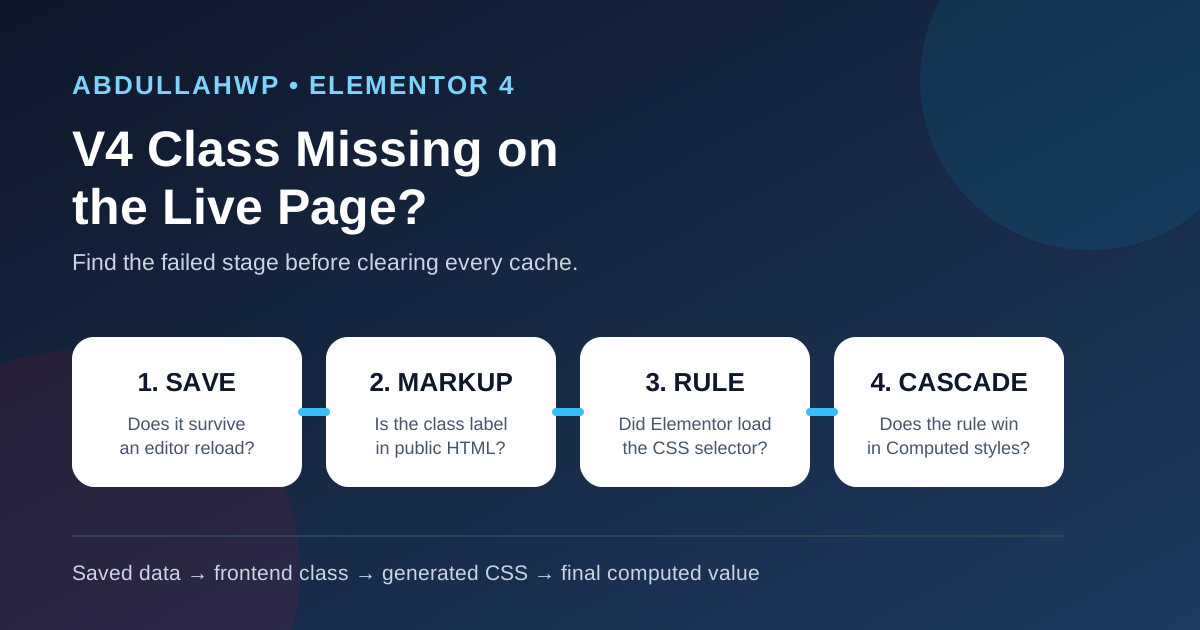
An Elementor V4 class can look correct in the editor and still fail on the public page. The important question is not “Which cache should I clear?” It is whether the class was saved, emitted in the frontend HTML, given a CSS rule, and allowed to win in the cascade.
This guide isolates those stages in order. It is specifically for Atomic Editor classes that are missing or inactive on the live page. For broader selector and cascade problems, use the Elementor custom CSS troubleshooting guide. For a generated stylesheet that is empty or returns 404, use the Elementor CSS 404 guide.
Quick answer: Publish the page, open the public URL in a private window, inspect the affected element, and search its class attribute for the V4 class label. If the class is absent, diagnose the save request, document revision, Class Manager record, and V3/V4 element boundary. If the class is present but no rule exists, diagnose generated CSS. If the rule exists but is crossed out, fix class order or specificity. Clear only the cache layer proven to be stale.
The four stages a V4 class must pass
| Stage | What must happen | Evidence to collect |
|---|---|---|
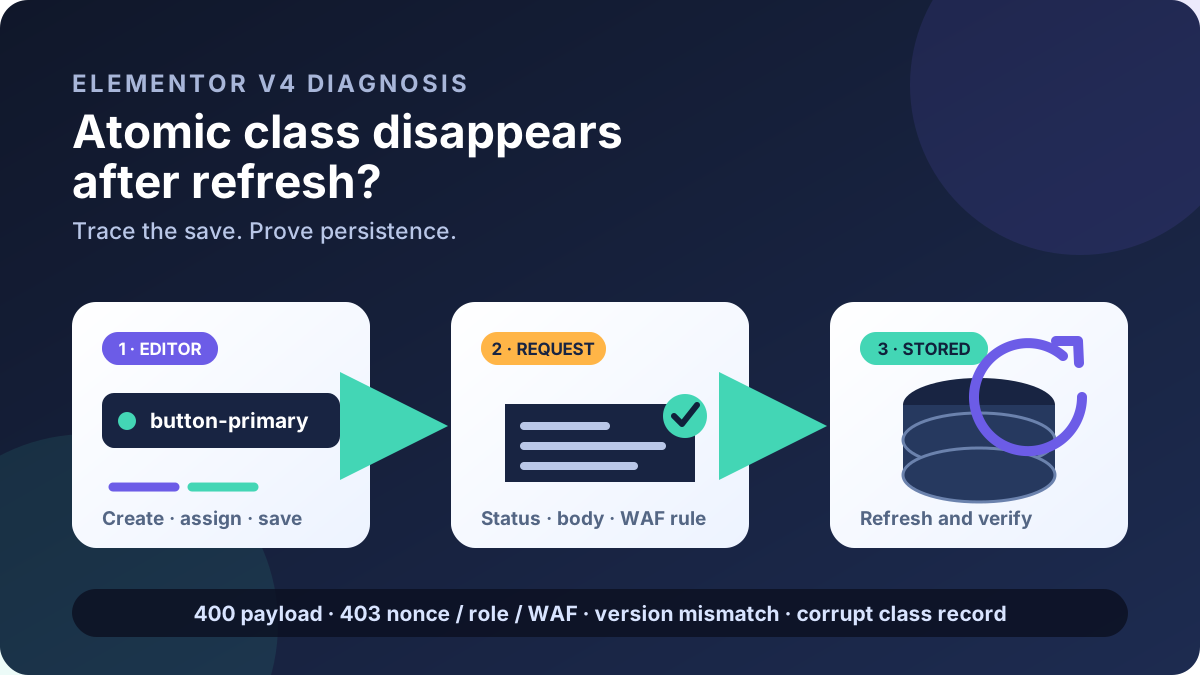
| Save | The class assignment and class definition are stored successfully | The editor save request returns success and survives a reload |
| Markup | The published frontend element receives the class label | The class appears in the public HTML |
| Rule | Elementor outputs a CSS rule for the class | DevTools finds the selector and declaration in a loaded stylesheet |
| Cascade | The intended rule beats conflicting local or global styles | The declaration is active in Styles and visible in Computed |
Elementor describes an Atomic style as a reusable class definition with an internal identifier, label, and variants. The internal ID connects the style to Elementor’s data layer, while the visible frontend class can follow the human-readable label. That distinction matters: do not search only for an internal g-... identifier and conclude that the class is missing.
In a live Elementor 4.2 test on AbdullahWP, Class Manager records were stored under internal IDs, while the published V4 buttons emitted readable labels such as button and blue-button. The correct test was whether those labels appeared on the intended element and had active rules—not whether the internal record ID appeared in the HTML.
Before testing, protect the working page
- Use staging for a business-critical page, checkout, form, header, or active campaign.
- Record WordPress, PHP, Elementor Core, Elementor Pro, theme, and relevant add-on versions.
- Save a revision or backup before deleting or recreating a class.
- Record the class label, affected element, breakpoint, state, and expected property.
- Test one small property such as a border or text color instead of changing the whole design system.
Do not delete a shared class as your first test. Class Manager changes can affect every element using that class. Duplicate the affected element or reproduce the issue on a staging page first.
Step 1: confirm the class actually saved
- Select the affected Atomic element.
- Write down the exact class label and the property you changed.
- Click Update and wait for the save to finish.
- Reload the editor completely.
- Select the same element and confirm that the class and property still exist.
If the class disappears after reloading, stop troubleshooting frontend CSS. The failure happened during saving. Open browser DevTools before clicking Update, select the Network panel, and inspect the failed WordPress/Elementor save request. A 400 response commonly points to invalid payload or rejected data; 403 points toward permissions, a nonce, a security plugin, ModSecurity, or a WAF; 500 requires the PHP/server error log.
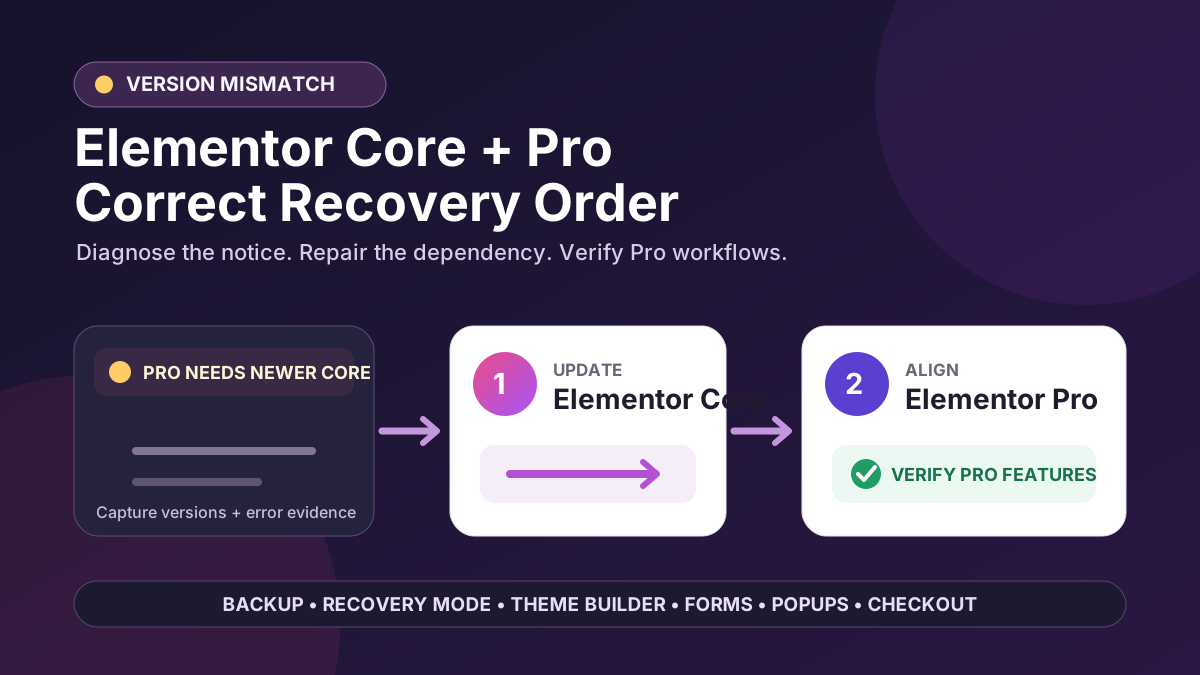
- Align Elementor Core and Pro versions.
- Confirm the user role can edit the document and Elementor templates.
- Check disk space and writable Elementor upload directories.
- Reproduce on staging with security and add-on conflicts isolated one at a time.
- Copy the response body and timestamp before changing settings; the status code alone is not enough.
Step 2: inspect the public HTML while logged out
- Open the final public URL in a private window.
- Right-click the affected element and choose Inspect.
- Check the element’s complete
classattribute. - Search for the readable V4 class label shown in Class Manager.
- Confirm you inspected the intended element, not a wrapper or a duplicate hidden at another breakpoint.
<a class="button blue-button e-button-base">
  Get a Free Quote
</a>
If the label is present, the class assignment reached the public markup. Continue to the CSS-rule test. If it is absent, compare the public page with the editor document:
- Confirm you edited the correct page, template, language, domain, and revision.
- Confirm the document is Published and that Update finished successfully.
- Check whether the selected item is a V4 Atomic element or a legacy V3 widget.
- Remove and reassign only the affected class on a staging copy.
- Create a uniquely named test class to rule out a label collision.
- Duplicate the element and test whether the duplicate emits the class.
Elementor’s V4 documentation says every Atomic element has a local class and can also receive reusable classes through the Classes field. Legacy V3 widgets use a different styling system. A mixed page is supported, but a class created for an Atomic element should not be expected to behave like a V3 Global Widget or V3 global style.
Step 3: find the generated CSS rule
With the element still selected in DevTools, open the Styles panel and search for the property or class label. Then use the Network panel to confirm that every Elementor stylesheet loaded with a successful response.
| Result | Meaning | Next action |
|---|---|---|
| Class present; rule present and active | Delivery works | Check the computed value and whether another property controls the visual result |
| Class present; rule crossed out | Cascade/order conflict | Reorder classes, remove an unnecessary local style, or make the intended selector appropriately specific |
| Class present; no rule found | Class definition or generated CSS is missing | Check Class Manager, generated files, print method, permissions, and CSS responses |
| CSS request is 404 | HTML references a missing generated file | Follow the dedicated CSS 404 workflow and find which process deleted or failed to create the file |
| Old rule appears only for visitors | Public cache is stale | Identify and purge the cache shown by response headers |
Elementor’s current troubleshooting guidance recommends using Elementor → Tools → Clear Files & Data when generated assets are stale. Use that after collecting the failing file URL and response—not as the first response to every styling problem. If the file returns 404 again, regeneration treated the symptom rather than the cause.
Step 4: fix class order and specificity
A class can be present and fully generated but still lose. Elementor V4 exposes class indicators and class ordering so you can see when styles conflict. Check these layers:
- Local class: a local element style may intentionally override a reusable class.
- Multiple global classes: two classes may set the same property; their order matters.
- Responsive variant: a tablet or mobile value may override the desktop value.
- State: hover, focus, active, or another state may be controlling what you see.
- Custom CSS/theme CSS: a later or more specific selector may win outside Class Manager.
Do not solve every conflict with !important. First remove an accidental local value, put reusable classes in the intended order, and check the failing breakpoint/state. Use a stronger custom selector only when the design system genuinely requires it.
Prove which cache is stale
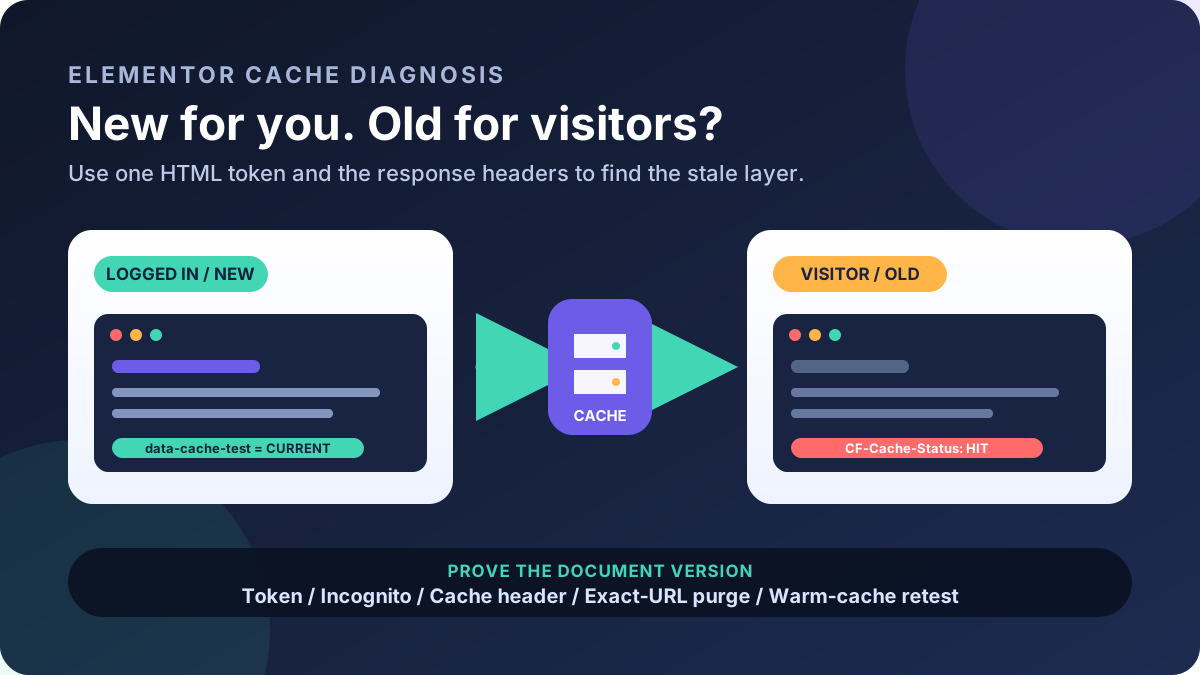
If the editor and logged-in page are correct but visitors see old markup, request the page privately and inspect response headers. Headers such as CF-Cache-Status, X-LiteSpeed-Cache, X-Cache, or Age identify an upstream copy. Purge that layer by URL, retest, and avoid clearing unrelated caches.
Fast proof: compare the affected element’s class attribute in a logged-in window and a private window. Different HTML means a document/cache delivery problem. Identical HTML with different appearance means a CSS, cascade, or asset problem.
Use this repair order
- Save and reload the editor to prove persistence.
- Confirm the correct published document and revision.
- Inspect the public class label.
- Find the generated selector and declaration.
- Resolve class order, local style, breakpoint, and state conflicts.
- Repair generated assets only when the rule or stylesheet is missing.
- Purge only a cache proven stale by markup or response headers.
- Retest desktop and mobile while logged in and out.
Success condition: the class survives an editor reload, its readable label appears on the intended public element, the expected declaration loads without an error, and the computed value is correct for logged-in and logged-out visitors at every required breakpoint.
Prevent the mismatch from returning
- Use a documented naming convention and avoid generic labels that collide with theme or plugin CSS.
- Prefer reusable classes over repeated local styles, but keep class responsibilities narrow.
- Test Elementor Core and Pro together on staging before updating production.
- Add a logged-out visual check to the deployment checklist.
- Monitor failed CSS requests and low disk space.
- Record cache ownership so editors know whether WordPress, the host, or a CDN stores public HTML.
- Keep V3-to-V4 migration changes in a reversible staging workflow; Elementor warns that style migration is not fully reversible.
Official references used for this workflow
- Elementor: changes do not appear online
- Elementor: explore V4 features and classes
- Elementor Developers: Atomic Styles data structure
- Elementor: V3 and V4 differences
- Elementor FAQ: current V4 limitations and migration guidance
Frequently asked questions
Why does the class show in Class Manager but not in HTML?
The document may not have saved the assignment, you may be viewing another revision or cached page, or the selected element may be a legacy V3 widget. First reload the editor, then inspect the exact published element while logged out.
Should I look for the internal class ID?
Not exclusively. Elementor’s data layer uses identifiers, but a global class can emit its label as the visible frontend class. Record both when diagnosing, and inspect the HTML for the label actually assigned in the editor.
Will clearing Elementor Files & Data fix a missing class?
Only when the assignment reached the HTML but the generated rule or referenced file is stale or missing. It cannot repair a failed save request, wrong document, class collision, or cascade conflict.
Can V4 classes style legacy V3 widgets?
Do not assume identical behavior. V4 Atomic elements and V3 widgets use different styling systems. Mixed pages are possible, but test the actual element type and use the styling controls intended for it.
Diagnose the missing stage, not the whole website
A V4 class problem becomes manageable when you separate saving, markup, rule generation, and cascade. Collect one piece of evidence at each stage, apply the smallest fix, and verify the public page privately. That approach avoids destructive class changes and prevents a cache purge from hiding the real cause.
If the page is business-critical and the class, generated file, or save response still cannot be explained, contact AbdullahWP for a focused Elementor diagnosis or review the available WordPress and Elementor services.