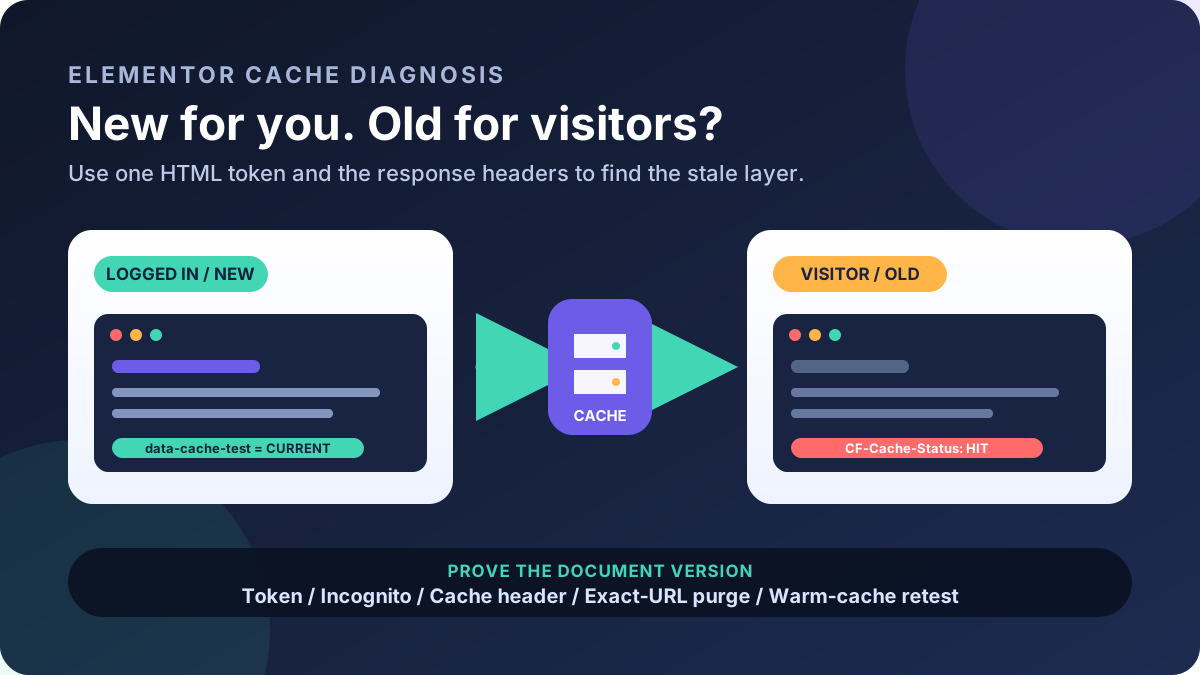
When Elementor looks updated only when logged in, the public page can still serve the old version to visitors. The edit is not necessarily missing. Logged-in requests commonly take a different delivery path, while anonymous visitors receive cached HTML from a WordPress plugin, the host, or a CDN.
This guide proves which public layer is stale before anything is cleared. It is narrowly about different page versions for logged-in and logged-out requests. If both requests contain the same current HTML but a style does not work, use the Elementor custom CSS troubleshooting guide. If an Elementor stylesheet returns 404, follow the separate Elementor CSS 404 workflow.
Quick answer: Add a temporary unique data attribute to one Elementor element, publish the page, and search for that token in the main document response while logged in and in a private window. If the logged-in response has the token but the private response does not, inspect the private response headers for a cache HIT. Purge that exact page from the layer named by the header, then verify the canonical URL again without a bypass parameter.
1. Diagnose the result before clearing a cache
| What the test shows | Likely layer | Next action |
|---|---|---|
| Logged-in document has the token; private document does not; a response header says HIT | Public full-page cache at the plugin, host, or CDN | Purge the exact page from the layer identified by the header |
| Canonical URL is old; a unique query-string URL is current | A cached variant of the canonical page | Compare both responses and purge the canonical URL; the query string is only a test |
| Both documents have the token, but styling or behavior is old | Minified or cached CSS/JavaScript asset | Inspect the asset response and purge or rebuild only that bundle or file |
| Private and second-device tests are current, but one normal browser is old | Browser cache, service worker, or extension | Clear data for that site and inspect service workers; do not purge the whole server |
| Document is fresh and reports a MISS, but one dynamic element is old | Element cache, fragment cache, or stale dynamic data | Test that element’s cache setting and data source separately |
| The token is missing from logged-in and logged-out responses | Wrong document, failed publish, draft, template, language, or domain | Confirm the edited document and successful Update before investigating cache |
2. Protect the page and record the current cache path
- Use staging for checkout, forms, logged-in portals, active campaigns, headers, footers, and other business-critical templates.
- Save an Elementor revision and record the page URL, template, language, and last successful edit time in UTC.
- List every performance layer: WordPress cache plugin, host page cache, reverse proxy, CDN, optimization/minification tool, and browser.
- Record current cache settings before changing an exclusion, TTL, development mode, or minification option.
- Use one test page or exact URL. Do not begin with Purge Everything.
Do not disable caching sitewide on a busy production site as the first test. A full purge creates a cold cache and can increase load while every page is rebuilt. It can also hide which layer failed. Start with an invisible token and an exact-URL comparison.
3. Add a safe, reversible Elementor test token
A color or spacing change is a weak test because CSS, breakpoints, and the cascade can change the result. A unique value in the HTML document proves which saved page version was delivered.
- Select a stable container or widget on the affected page.
- With Elementor Pro, open Advanced > Attributes.
- Add a unique line in Elementor’s documented
key|valueformat, such asdata-cache-test|e25-20260724-1435z. - Click Update and wait for the save to complete.
- Reload the editor and confirm the attribute remains.
Use a new UTC timestamp for each run so an earlier copy cannot create a false positive. The data-* attribute is invisible and does not alter layout or accessibility. If Elementor Pro custom attributes are unavailable, use a staging page and add a temporary, neutral text token instead. Avoid an HTML comment because an HTML minifier may remove it.
Next, open DevTools, select Network, reload, click the first request whose type is document, and search its Response for the token. Search the network response rather than only the Elements panel; JavaScript can change the live DOM after the server response arrives.
4. Compare logged-in and private document responses
- Load the exact canonical URL in the logged-in window and record whether the document response contains the token.
- Open a new private or incognito window and load the same scheme, host, path, and trailing slash.
- In the private window, inspect the document response, status code, response headers, and token.
- Reload the private page once. A first request may be a MISS and the next a HIT as the public cache warms.
- Save the two header sets or screenshots before purging anything.
Incognito removes the logged-in cookie and starts with a fresh local browser profile, which makes it a good anonymous test. It does not bypass Cloudflare, Varnish, LiteSpeed, Nginx FastCGI cache, or another shared upstream cache. If private browsing still shows the old document, that is expected when the stale copy lives outside the device.
5. Use a bypass URL as a comparison, not a cure
Request a one-time URL such as:
https://example.com/landing-page/?awp_cache_test=e25-20260724-1435zIf the canonical URL is old but this unique URL contains the new token, a cache-key difference is strong evidence that the canonical page is stale. Compare the headers from both requests. Do not treat the parameter as a universal bypass: a host or CDN may ignore selected query strings, normalize them, or use a custom cache key. The parameter also does not delete the old cached object.
Do not share, link to, or submit the test URL for indexing. The repair is complete only when the normal canonical URL is current for a logged-out visitor. DevTools’ Disable cache option is also local to that browser session; it does not purge a host or CDN.
6. Read the cache headers without over-interpreting them
| Header or signal | What it proves | What it does not prove |
|---|---|---|
CF-Cache-Status: HIT | Cloudflare served this response from its edge cache | That the origin or a lower cache also has the current page |
Age: 412 | The stored response has spent about 412 seconds in the reporting cache | Which product owns the cache when read alone |
X-LiteSpeed-Cache: hit | LiteSpeed served a cached response | That a CDN above LiteSpeed has no separate copy |
X-Cache: HIT or X-Kinsta-Cache: HIT | A host or proxy cache reports a hit | The identity of a generic X-Cache header without provider context |
Cache-Control | The caching policy and lifetime sent with the response | That this particular response was definitely served from cache |
| Header says MISS but HTML is old | The reporting layer fetched a response rather than using its own stored copy | That WordPress, a plugin, or a lower host cache generated fresh HTML |
Best evidence: keep the token result, full document URL, response status, cache header, Age, request time, and location together. A HIT plus an absent token identifies a stale copy. A MISS plus an absent token means you must continue toward the origin instead of declaring the CDN innocent or guilty.
WordPress has no single header that identifies every page-cache plugin or host. Provider documentation is the authority for its own header names. If a generic header is ambiguous, ask the host which layer sets it and include the captured response.
7. Purge the exact stale layer and URL
- WordPress page-cache plugin: purge the affected page or URI using the plugin’s supported control. Do not flush Redis merely because it also contains the word cache.
- Host page cache: use the host panel’s page or path purge when available. Include the precise scheme, hostname, path, and trailing slash expected by that platform.
- Cloudflare or another CDN: purge the exact public page URL. Cloudflare documents that the next request after a successful single-file purge should report a MISS.
- Browser: when every anonymous remote test is current but one device is old, clear data for that site or hard reload that device.
If the evidence shows several stale layers, purge from the origin outward: WordPress plugin, host/reverse proxy, then CDN. Otherwise, an edge purge can immediately refill from an old lower-level copy. Verify after each meaningful step so you can identify the failed invalidation.
Use Purge Everything only when an exact purge is unavailable, a shared Elementor template affects many URLs, or custom cache variants cannot be targeted safely. Cloudflare warns that custom cache keys containing headers or cookies may require an API purge with those values, a prefix/tag purge, or a wider purge. A template update may also require purging every public page where that header, footer, popup, or Loop template appears.
8. Separate stale HTML from minified CSS and JavaScript
When the private document contains the current token, full-page HTML is no longer the failing layer. Inspect the CSS or JavaScript request responsible for the old appearance or behavior:
- Confirm the document references the expected current asset URL.
- Open the asset response and search for a unique selector, rule, or code change.
- Read cache headers on the asset itself; they can differ from the document headers.
- If an optimization plugin created a combined or minified bundle, rebuild that bundle and purge its exact CDN URL.
- If the document points to an old bundle name, purge the HTML layer that supplied that reference.
- If an Elementor
post-*.cssfile is missing or returns 404, switch to the dedicated generated-CSS workflow instead of broad cache clearing.
Elementor’s Clear Files & Data tool is appropriate when an Elementor-generated asset is proven stale or missing. It is not the first fix for cached old HTML. Likewise, a persistent object cache stores reusable WordPress data while PHP runs; it is not the same as a finished public page snapshot. The WordPress object cache and Redis guide explains that boundary.
9. Verify the repair while the cache is warm
- Request the canonical URL in a fresh private window, without the test query string.
- Confirm the document response contains the current token.
- Reload until the public layer reports a HIT again and confirm that the HIT response still contains the token.
- Compare the logged-in page with the logged-out page at desktop and mobile widths.
- Test from a second device or mobile-data connection to reduce local and network bias.
- Confirm the relevant CSS and JavaScript requests return successful responses and current content.
- Test the page’s real workflow: menu, form, popup, login, cart, or checkout as applicable.
- Remove the temporary attribute, click Update, purge the affected URL through the repaired path, and confirm the token disappears from the warm public response.
Success: the canonical URL matches for logged-in and logged-out users, a warmed public HIT contains the current page version, required assets are current, the test token disappears after removal, and the page’s business workflow passes on desktop and mobile.
10. Roll back test changes and prevent a repeat
- Remove the test attribute or text and restore any cache, minification, delay, or exclusion setting changed during diagnosis.
- Turn off temporary CDN development modes. Cloudflare states that Development Mode bypasses edge cache temporarily but does not purge stored files.
- Enable or repair automatic exact-URL invalidation when a page is updated.
- Map shared templates to their public URLs so a header, footer, popup, or Loop edit purges every affected page.
- Keep one clearly documented owner for each full-page cache layer and avoid running competing WordPress page-cache plugins.
- Exclude personalized, account, cart, checkout, and other unsafe dynamic responses according to the plugin and host documentation.
- Do not enable Elementor Element Caching on content that uses dynamic tags or visitor-specific data; Elementor warns that those elements are not suitable for it.
- Add one logged-out, warm-cache check to the Elementor update and deployment checklist.
If an exact purge works once but the old version returns, inspect the refill path. The CDN may be retrieving stale HTML from the host, a WordPress plugin may not invalidate on template updates, or a custom device, country, language, cookie, or query-string cache key may keep several variants of the same page.
Official sources used for this workflow
- Elementor: changes do not appear online
- Elementor: custom attributes
- Elementor: Element Caching behavior and limits
- Elementor Hosting: advanced page caching
- Cloudflare: cache response headers
- Cloudflare: purge by single URL
- Cloudflare: Development Mode
- LiteSpeed: cache status headers
- WP Engine: server, browser, and edge cache testing
- WordPress Developer Reference: no-cache response headers
Frequently asked questions
Why do administrators see the new Elementor page first?
A WordPress login cookie often causes full-page caches to bypass or vary the response, so the administrator reaches WordPress or a private cache variant while anonymous visitors receive stored public HTML. Confirm that behavior with the document headers rather than assuming every host works the same way.
Does incognito mode bypass Cloudflare or my host cache?
No. It supplies a fresh local browser profile and removes the logged-in cookie, but shared edge and server caches remain in the request path. That is why the private response headers matter.
Does adding ?nocache=1 clear the cache?
No. It may request a different cache key and reveal a fresh response, but it does not delete the canonical cached page. Some configurations ignore that parameter entirely. Use it only as a comparison and repair the canonical URL.
Should I clear Elementor Files & Data?
Only when the evidence points to an Elementor-generated file or data cache. If the private document itself is old and reports a page-cache HIT, regenerate nothing until that HTML layer is addressed.
Why did the old page return after I purged the CDN?
The CDN may have refilled from a stale host or plugin cache, or you may have purged only one custom cache-key variant. Capture the new MISS response, inspect its token, and continue toward the origin.
Fix the invalidation path, not just today’s copy
The logged-in versus visitor mismatch becomes predictable when you compare the same document, carry a unique token through it, and read the response headers. Purge the layer that demonstrably served the old page, verify again after the cache warms, and repair the automatic invalidation that failed.
If a production page still refills with old HTML or several cache providers obscure the response path, review the available WordPress and Elementor troubleshooting services for a focused cache-layer diagnosis.