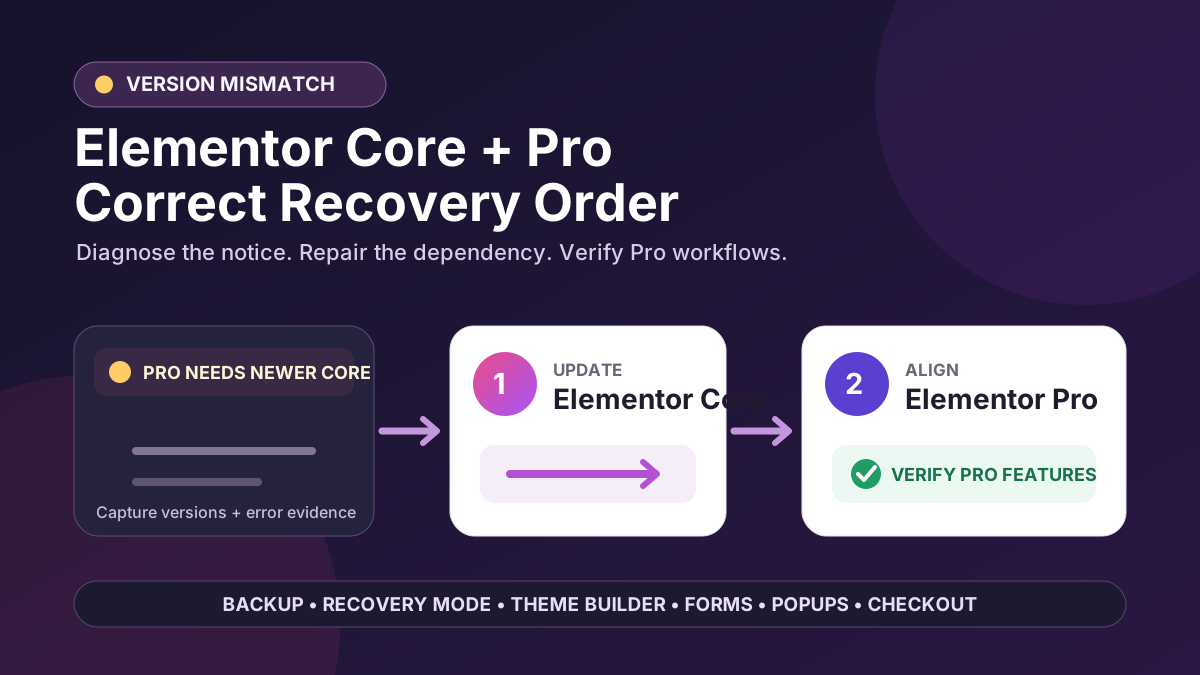
The message “Elementor Pro requires a newer version of Elementor” means the paid add-on and the free Elementor plugin are no longer a compatible pair. You may see only an admin notice, or the mismatch may block the editor, remove Pro controls, or trigger a fatal error before WordPress can load the dashboard.
The safe fix is not to keep clicking Update at random. Record the installed versions, protect the site, repair the dependency in the order required by the exact failure, and then test the Pro features that generate leads, templates, and sales.
Quick answer: For the specific “Elementor Pro requires a newer version of Elementor” notice, update the free Elementor plugin first, then update or reactivate Elementor Pro. If a fatal error prevents access, use WordPress Recovery Mode or rename the elementor-pro plugin folder through SFTP, repair the free plugin, install a fresh stable Pro copy, and test every Pro workflow before reopening the site.
1. Identify the mismatch before changing anything
Elementor Pro is an add-on to the free Elementor plugin, often called Elementor Core. Pro can call functions supplied by Core, while a newer Core release can also change functions expected by an older Pro release. That is why either side of a mismatched pair can fail.
| Symptom | Evidence to collect | Safest next action |
|---|---|---|
| “Pro requires a newer version of Elementor” notice | Core and Pro versions on Plugins screen | Update Core, then update/reactivate Pro |
| Notice remains although Core appears current | Available updates, Pro version, changelogs, System Info | Check again for updates; install the latest stable Pro package |
| Fatal error names a missing Elementor method | Recovery email or PHP stack trace | Pause the plugin named in the trace and align the pair |
require(), namespace, or missing-file fatal | Exact file path, update log, disk space, permissions | Replace the incomplete plugin folder with a fresh package |
| Pro update says Unauthorized | License status and failed update response | Reconnect the license or upload Pro from My Elementor |
| Error names a third-party Elementor add-on | Stack trace and add-on compatibility statement | Update or pause that add-on; do not blame Core without proof |
Do not assume Core and Pro must display the same version number. They are released on separate schedules. The useful question is whether the installed stable versions are compatible, not whether their numbers look identical.
Important documentation conflict: Elementor’s error-specific Pro update page says to update Core first for this notice, while its newer general update guide recommends Pro first for a routine paired update. Treat the exact error as the deciding evidence: repair the Core dependency first here. For a planned update with no error, follow the release notes on staging and keep the time between the two updates as short as possible.
2. Protect the site and prepare both packages
Use a production-like staging copy whenever the live site has forms, memberships, bookings, or WooCommerce. Elementor recommends a backup, release-note review, add-on compatibility check, and staging test before updates. The broader Elementor update checklist covers that full change-control process.
- Create a complete backup of the database and files, including
wp-contentandwp-config.php. - Confirm that the backup can be restored; a green backup notification is not a restore test.
- Record WordPress, PHP, theme, Elementor Core, Elementor Pro, WooCommerce, and Elementor add-on versions.
- Download the current stable Elementor Pro ZIP from the My Elementor account before starting.
- Confirm enough disk space and that WordPress can write to
wp-content/plugins. - Choose a low-traffic window and define the failure that will trigger rollback.
Store and lead-site warning: Restoring a full database can erase orders, form submissions, users, bookings, or comments created after the backup. Prefer a short maintenance window, package-level repair, or a transaction-preserving rollback plan over a blind full-site restore.
3. Confirm the versions and the failed layer
- Open Plugins > Installed Plugins and copy the exact Core and Pro version numbers.
- Open Dashboard > Updates, click Check again, and record which package WordPress offers.
- Download Elementor System Info from Elementor > Editor > System. Review its compatibility tags for third-party extensions.
- Read the Core and Pro changelogs for minimum requirements, migrations, deprecations, and known fixes.
- If the site is failing, copy the first relevant fatal error and its file path from the recovery email or PHP log.
The first useful stack entry normally identifies Core, Pro, or a third-party extension. A PHP fatal cannot be repaired by clearing a browser cache. Likewise, a 404 for a generated stylesheet after the versions are aligned is an asset problem, not proof that the pair is still incompatible. Use the Elementor CSS 404 guide for that separate layer.
Tip: Take screenshots of the Plugins screen and Elementor System Info before updating. They give you a reliable “before” state and make a support request far more useful than “Elementor broke after an update.”
4. Fix “Pro requires a newer Elementor version” when wp-admin works
- Put the live site into a controlled maintenance window if Pro templates or transactions are business-critical.
- From Dashboard > Updates, update the free Elementor plugin first. Wait for WordPress to report completion; do not reload during file replacement.
- Return to the Plugins screen and confirm the new Core version actually installed.
- Update Elementor Pro to the latest compatible stable release. If Pro was paused, reactivate it only after Core is ready.
- If the Pro update is unavailable or unauthorized, verify the license connection. Then download Pro from My Elementor and use Plugins > Add New Plugin > Upload Plugin to replace it.
- Reopen Elementor System Info and confirm that the warning is gone and no third-party add-on reports an unresolved compatibility tag.
If WordPress itself is below Elementor’s current minimum, test and update WordPress first, then Core, then Pro, as Elementor’s error guide directs. Do not combine a WordPress, PHP, theme, Core, Pro, WooCommerce, and add-on upgrade into one untraceable click. The WordPress plugin audit helps map the dependencies before a larger maintenance window.
5. Recover when the mismatch causes a fatal error
Use WordPress Recovery Mode first
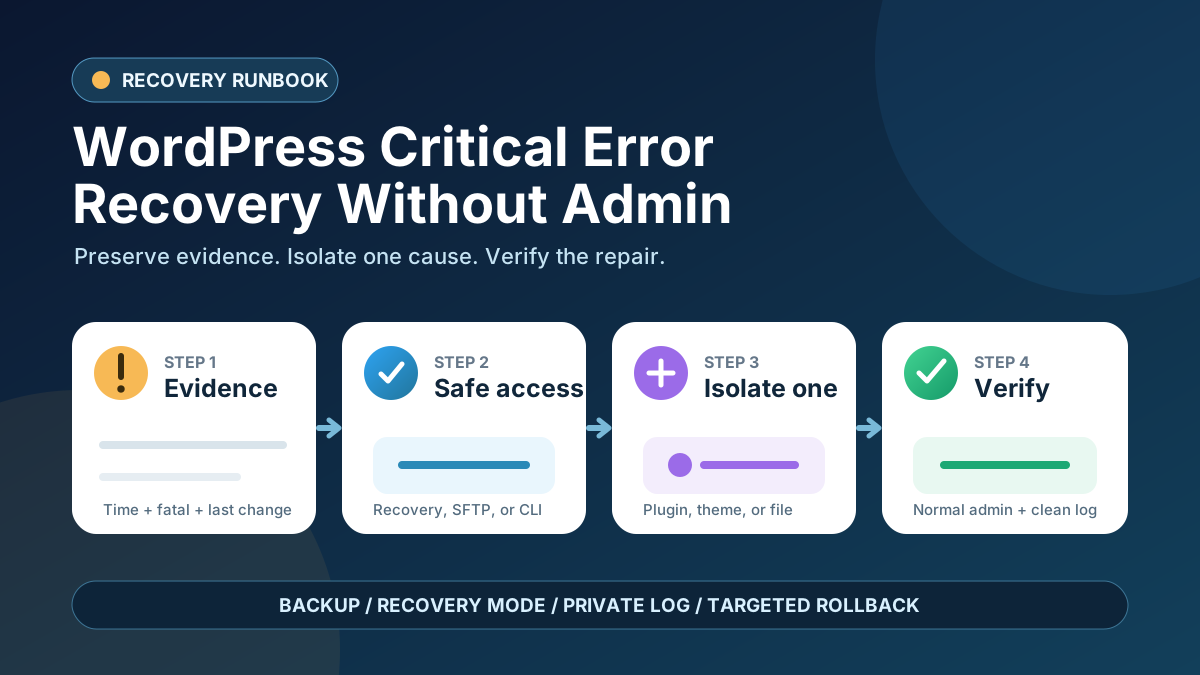
WordPress Recovery Mode can pause the faulty plugin for your administrator session while visitors continue to receive the normal site behavior where possible. Open the special link sent to the site administration email, log in, and read the notice that identifies the paused component.
- If Pro is named, leave it paused for the recovery session.
- Update or reinstall Core to the stable version required by Pro.
- Install the latest stable Pro package and reactivate it.
- Exit Recovery Mode only after the dashboard, editor, and public pages load without a new fatal.
Use SFTP or the hosting file manager if no recovery email arrives
Go to wp-content/plugins and rename elementor-pro to elementor-pro.disabled. Renaming is reversible and deactivates Pro when WordPress next loads. If the stack trace instead shows incomplete Core files, rename the elementor folder and upload a clean stable Core package from WordPress.org.
After wp-admin returns, install the required Core release, upload the current Pro ZIP from My Elementor, and activate the fresh Pro copy. Keep any renamed old folder inactive; never rename it over the new folder. If a partially copied directory remains, preserve a copy for the log record, then replace the entire affected plugin folder rather than mixing old and new files.
Do not leave Pro disabled on a public site: Elementor says designs are retained and reappear after Pro is reactivated, but Pro widgets, Theme Builder output, forms, popups, and ecommerce features can be missing or nonfunctional while the plugin is inactive. Use maintenance mode or complete the repair promptly.
If the editor still spins after the pair is compatible, move to the evidence branches in the Elementor editor loading guide instead of repeatedly reinstalling the same plugins.
6. Replace a partial or corrupted update safely
A missing-file, namespace, or failed require() error often points to an interrupted copy rather than ordinary compatibility. Check free disk space, inode limits, folder ownership, and the failed update message before retrying. Elementor’s update-error guide lists 755 for directories and 644 for files as common permissions, but ownership and server policy still matter; ask the host to correct them instead of applying broad permissions blindly.
- Download a fresh stable package from the official source: Core from WordPress.org and Pro from My Elementor.
- Deactivate or rename the affected plugin folder.
- Move the incomplete folder aside so old files cannot remain mixed with the replacement.
- Upload the complete replacement folder and confirm its standard name is
elementororelementor-pro. - Activate Core first for this dependency error, then activate Pro.
- Review the PHP log once more for a new fatal before clearing old log entries.
7. Run Pro acceptance tests before declaring success
| Pro area | Minimum acceptance test |
|---|---|
| Editor | Open a representative page, change harmless text on staging, save, reload, and inspect the public page logged out |
| Theme Builder | Check header, footer, single, archive, search, and 404 templates at URLs covered by their display conditions |
| Forms | Submit each critical form; verify validation, saved submission where enabled, email or integration delivery, and success state |
| Popups | Test click and automatic triggers logged out, conditions, frequency cookies, close behavior, mobile, and keyboard access |
| Loops and dynamic content | Check the first page, pagination or Load More, filters, dynamic fields, empty states, and logged-out output |
| WooCommerce | Test a real product and variation, add to cart, coupon, shipping, checkout fields, sandbox payment, order creation, callback, and email |
| Assets and logs | Confirm no new JavaScript errors, PHP fatals, or missing Elementor CSS/JS requests |
Run the same short matrix on staging and production. Test both an administrator session and a private window because page cache, role permissions, and popup cookies can hide failures. A successful plugin update screen proves only that files were copied; it does not prove that a lead arrived or a payment callback completed.
Success: Core and Pro form a supported stable pair, the compatibility notice is gone, the editor saves, public templates render for logged-out visitors, forms and popups complete their actions, loops paginate, checkout creates a test order, and the PHP/browser logs show no new errors.
8. Roll back without creating the opposite mismatch
Elementor’s Version Control screen can reinstall an earlier Core or Pro version when wp-admin works. Its official direct-download rollback method applies to Core; obtain Pro packages through your Elementor account or a verified backup. Always back up before rolling back.
- Roll back Core and Pro to a pair already proven on staging, not two arbitrary old releases.
- Do not roll back only Core if the installed Pro release requires newer Core.
- Remember that plugin rollback may not reverse database migrations or changes made by add-ons.
- A full backup restore can remove new transactions; choose file/package rollback when that is enough.
- Do not stay on an old vulnerable release as a permanent fix. Escalate the incompatibility and plan the supported update.
9. Prevent the mismatch from returning
- Keep an active Pro license so the paid plugin can receive compatibility and security updates.
- Do not let Core auto-update indefinitely while Pro is frozen on an expired or unavailable release.
- Stage Core and Pro releases together and keep their mismatch window brief.
- Read both changelogs and check third-party compatibility tags before deployment.
- Keep a restorable backup and the previous known-good packages for the maintenance window.
- Monitor the editor, forms, popups, checkout, PHP errors, and failed update emails after deployment.
Frequently asked questions
Do Elementor Core and Pro version numbers have to match?
No. Core and Pro have separate release schedules, so identical version numbers are not the compatibility test. Use stable releases, current changelogs, the Plugins screen, Elementor System Info, and a staging acceptance test.
Should I update Elementor Core or Pro first?
For the exact “Elementor Pro requires a newer version of Elementor” notice, update Core first and then Pro. For a routine paired update without that error, Elementor’s current general and error-specific pages give different ordering guidance, so follow the release notes on staging and minimize the interval between updates.
Will deactivating Elementor Pro delete my designs?
Elementor says the designs remain and reappear when Pro is reinstalled or reactivated. However, Pro-generated output and business functions can disappear while Pro is inactive, so use the method as short-term recovery, not a normal operating state.
Can clearing caches fix a Core-Pro fatal error?
No. Clear or regenerate files after the versions are compatible if stale CSS or HTML remains. A PHP fatal caused by missing methods or files requires compatible, complete plugin code first.
Official sources
- Elementor: Pro update errors and the newer-Core notice
- Elementor: Update Elementor and Elementor Pro
- Elementor: Fatal error after an update or installation
- Elementor: Steps to take before updating
- Elementor: Roll back to a previous version
- Elementor: System Info and compatibility tags
- Elementor FAQ: Core, Pro, and design retention
- WordPress: Recovery Mode
If the site is already down or its forms and checkout are at risk, see AbdullahWP services for a controlled Elementor recovery and verification plan.